
The certification deadline may move. Your DFARS obligations do not.
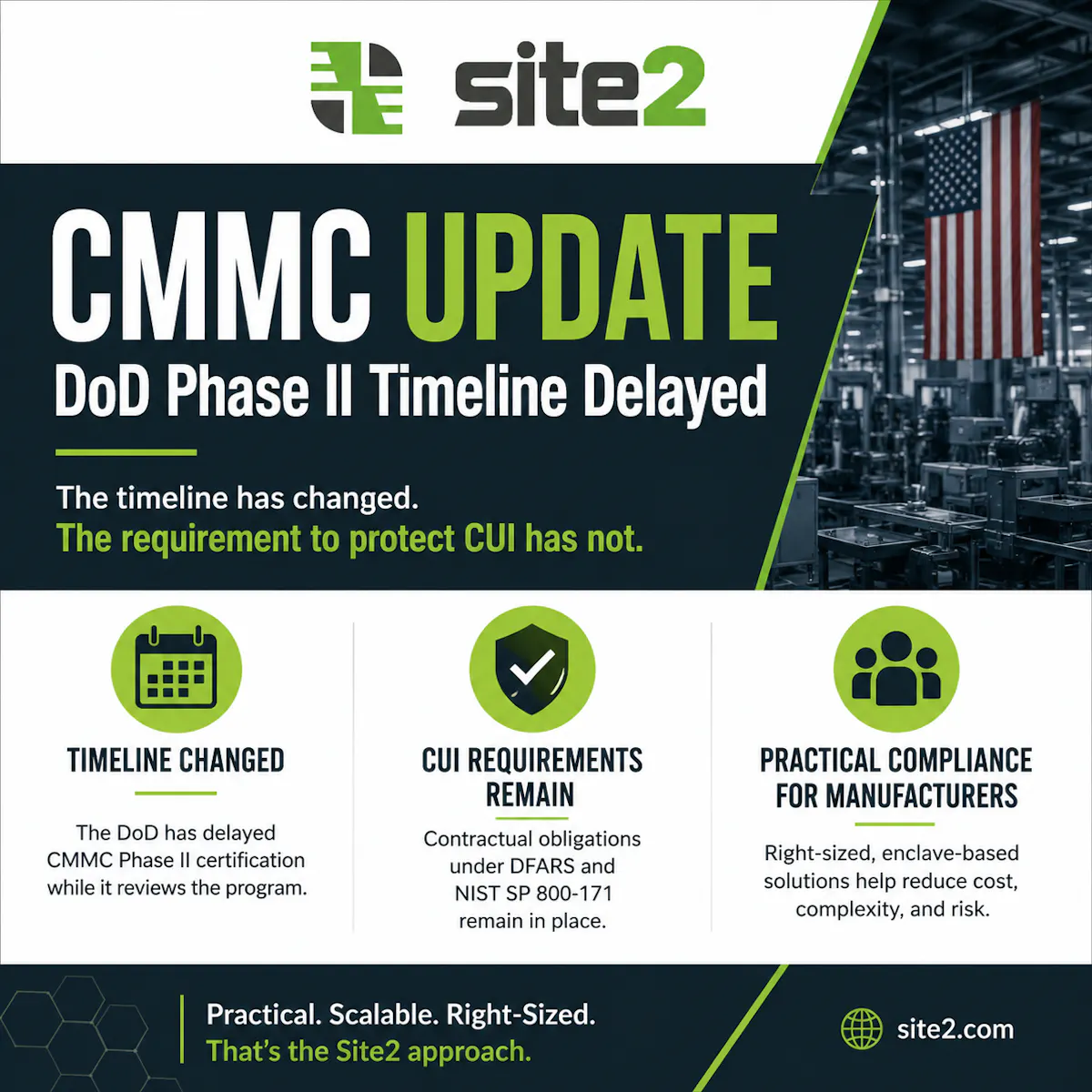
CMMC Phase II has been suspended. The requirement to protect CUI has not.
The suspension pauses the planned expansion of third-party certification requirements. It does not suspend applicable Phase I self-assessment and affirmation requirements, nor the existing DFARS 252.204-7012 obligation to implement NIST SP 800-171.
That DFARS requirement has been in place since December 31, 2017. For an applicable Level 2 assessment, contractors must address all 110 NIST SP 800-171 Revision 2 requirements and demonstrate them against 320 assessment objectives. CMMC validates the work; it did not create the underlying obligation.
If a company handling CUI is not already compliant, it may have been waiting too long. A DIBCAC assessment, prime-contractor risk review, SPRS verification, customer request, or new opportunity does not have to wait for Phase II.
Pausing a third-party assessment may defer an assessor expense. It does not defer the cost of scoping CUI, implementing safeguards, documenting evidence, training people, or maintaining the program.
The practical question is not, “How long can we wait?” It is, “How much more expensive will readiness become if a customer, prime contractor, solicitation, audit, or incident forces us to act?”
Waiting Does Not Remove the Work. It Creates Readiness Debt
Readiness debt is a simple idea: it is the extra cost, risk, and disruption created by postponing CMMC work the organization already has to do.
The term borrows from technical debt, but the business effect is straightforward: delay reduces your options and compresses required work into a shorter, more expensive window.
Six ways readiness debt grows
In plain English: waiting makes the same required work harder, faster, and more expensive to complete.
1. Compliance boundary expansion: More users, systems, locations, and vendors enter scope.
2. Evidence reconstruction: Documentation becomes harder to produce and defend.
3. Limited POA&M flexibility: Deferred work may not qualify for later remediation.
4. DIBCAC and customer scrutiny: Reviews can arrive before Phase II certification resumes.
5. Rushed implementation: Emergency timelines increase cost, disruption, and rework.
6. Unsupported representations: Weak evidence creates contractual and legal exposure.
Readiness debt rarely appears as one large invoice. It builds quietly as more systems handle CUI, more employees gain access, more cloud tools are adopted, more subcontractors enter the workflow, and policies fall behind actual practices.
Then a contract opportunity, prime-contractor review, or DIBCAC assessment arrives, and the organization discovers that the work was not avoided. It was compressed.
The Certification Pause Does Not Pause Implementation Costs
The current CMMC reform review is important. It may change how third-party certification is implemented, how costs are managed, or how requirements are applied to smaller organizations.
What it does not do is erase the underlying responsibility to protect sensitive defense information, or the investment required to meet that responsibility.
Organizations with applicable DFARS 252.204-7012 requirements must still provide adequate security for covered contractor information systems, implement the applicable NIST SP 800-171 requirements, report qualifying cyber incidents, and flow the clause down to relevant subcontractors. Current NIST SP 800-171 DoD assessment and SPRS requirements also remain part of the contracting environment.
A C3PAO assessment expense may be delayed for some organizations. The costs of scoping, remediation, documentation, governance, training, and ongoing evidence are not. This is why manufacturers should not build their cybersecurity strategy around one implementation date.
1. Delay Expands Your Compliance Boundary
CMMC cost is heavily influenced by scope.
The more users, devices, facilities, cloud services, business applications, and external providers that process, store, transmit, or protect CUI, the more complex the environment becomes to secure and assess.
Waiting allows that environment to grow without a deliberate boundary. Engineering files move through email. Teams share documents through general-purpose collaboration tools. Remote users access sensitive data from unmanaged locations. Vendors become embedded in workflows before anyone evaluates their responsibilities.
By the time the company starts formal readiness work, the compliance boundary may be far larger than the business actually needs.
An appropriately designed CUI enclave can sometimes reduce that burden by isolating sensitive work to a smaller set of systems and users. But an enclave is not a shortcut around compliance. It is a disciplined boundary decision that must reflect how CUI actually flows through the business.
The earlier you make that decision, the more options you have. The longer you wait, the more expensive it becomes to unwind established processes.
2. Delay Creates Evidence Debt
CMMC is not satisfied by saying a security control exists. The organization must be able to demonstrate that the control is implemented, operating as intended, and supported by evidence.
That evidence may include policies, procedures, system configurations, access records, training records, inventories, diagrams, incident-response tests, change-management records, and other artifacts tied to the assessment objectives.
The CMMC rules also require assessment artifacts to be retained for six years. Annual affirmations require a senior official to attest to continuing compliance. That makes documentation an operating responsibility, not an assessment-week exercise.
When companies delay, they often continue doing security work without building the evidence system around it. Later, they must reconstruct months or years of decisions, ownership, testing, and configuration history.
That is expensive because undocumented work often has to be repeated. In an assessment, a control that cannot be demonstrated may be treated very differently from a control the team believes it performs.
3. A POA&M Is Not a Rescue Plan
Some organizations assume they can wait, identify gaps at the end, and place the remaining work on a Plan of Action and Milestones (POA&M).
That assumption is risky.
CMMC does not allow unlimited use of POA&Ms. Level 1 does not permit them. At Level 2, conditional status is available only under defined scoring conditions, certain requirements cannot be placed on a POA&M, and remaining items must be closed within 180 days.
In other words, a POA&M may help manage a limited set of remaining items. It is not a substitute for foundational readiness.
If your System Security Plan is incomplete, your CUI boundary is unclear, high-value requirements are not met, or the evidence does not exist, the organization may not have the safety net it expected.
4. DIBCAC and Prime Contractor Pressure Can Arrive Before Phase II
The Phase II schedule is only one source of pressure.
DIBCAC assesses contractor implementation of DFARS 252.204-7012, NIST SP 800-171, and the DoD assessment requirements in DFARS 252.204-7020. A DIBCAC Medium or High assessment does not need to wait for CMMC Phase II, and contracting officers may verify current SPRS scores for covered systems before award.
Prime contractors also have their own supply-chain responsibilities. They may ask subcontractors for current SPRS information, cybersecurity documentation, contract representations, or other evidence before sharing CUI or including a supplier in a proposal.
That means a manufacturer may feel the operational and commercial impact of readiness before a C3PAO certification requirement appears in a federal solicitation.
A supplier that can clearly explain what CUI it handles, where it resides, which systems are in scope, who owns the program, what its current assessment says, and how deficiencies are being managed creates less risk for the customer. Readiness becomes part of supplier credibility.
5. Rushed Compliance Is More Expensive Compliance
Cybersecurity work is rarely cheaper when performed under deadline pressure.
A rushed program often produces:
Emergency consulting and implementation costs.
Technology purchases made before scope is understood.
Duplicate tools and overlapping controls.
Operational disruption from last-minute process changes.
Rework caused by incomplete documentation or unclear ownership.
Limited time to test whether controls work in the real environment.
Leadership pressure to make representations before the evidence is mature.
The cost is not simply what you pay an advisor, assessor, or technology provider. It includes the internal time required from executives, IT, operations, human resources, legal, finance, and the employees who actually handle sensitive information.
Planned readiness allows that work to be sequenced. Emergency readiness forces it to compete with production, customer delivery, and normal business operations.
6. Inaccurate Claims Can Become More Than a Technical Problem
The Department of Justice has continued pursuing cybersecurity-related False Claims Act matters involving government contractors. Recent settlements have addressed allegations such as failure to meet contractual cybersecurity requirements, use of noncompliant third-party services, and inaccurate representations about compliance.
The lesson is not that every deficiency automatically becomes fraud. Cybersecurity programs are complex, and gaps can exist even in responsible organizations.
The risk increases when a company knowingly misrepresents its posture, submits unsupported scores or affirmations, ignores contractual requirements, or continues making claims that the evidence does not support.
Starting early gives leadership time to understand the facts, correct gaps, and make accurate representations. Waiting increases the likelihood that commercial pressure and incomplete evidence collide.
CMMC Readiness Is Now a Sales Capability
Most CMMC conversations begin as compliance conversations. We believe manufacturers should also view readiness as a revenue capability.
A mature program can help the organization:
Respond to customer security questionnaires more efficiently.
Demonstrate lower supplier risk to prime contractors.
Pursue opportunities without beginning readiness from zero.
Reduce uncertainty during due diligence and proposal review.
Protect the relationships and information that support long-term defense work.
This does not mean marketing a certification the company has not earned or promising that readiness guarantees a contract.
It means recognizing that the ability to protect sensitive information, explain your environment, and support your claims with evidence can make your company easier to trust and easier to buy from.
The practical truth
The deadline is not the only clock. Your next customer request, subcontract, cyber incident, acquisition opportunity, or leadership affirmation may arrive first.
What Manufacturers Should Do in the Next 90 Days
The right response is not to panic or purchase every tool associated with CMMC. It is to create a controlled readiness plan.
Days 1–30: Establish the facts
Review current and expected contracts for applicable FAR and DFARS clauses.
Identify where FCI and CUI enter, move through, and leave the organization.
Name an executive owner and a day-to-day program owner.
Confirm the current SPRS score, assessment date, assumptions, and supporting evidence.
Inventory users, devices, locations, applications, cloud services, and external providers connected to the CUI workflow.
Review the System Security Plan for accuracy—not just completeness.
Days 31–60: Control scope and prioritize risk
Validate the CMMC assessment scope against actual business processes.
Evaluate whether a properly designed enclave could reduce unnecessary complexity.
Conduct a structured CMMC Readiness Review against the applicable requirements and assessment objectives.
Separate technical gaps from documentation, governance, training, and process gaps.
Review cloud and external service providers, including shared-responsibility documentation.
Create a remediation plan based on contractual risk, assessment impact, business risk, cost, and dependency.
Days 61–90: Build proof and operating discipline
Remediate the highest-impact gaps first.
Update policies, procedures, diagrams, inventories, and responsibility matrices.
Test incident response, access control, change management, backup, and monitoring processes.
Create a repeatable evidence-retention structure.
Run an internal readiness review using the assessment objectives.
Establish a monthly compliance cadence so the program does not depend on one future assessment date.
Seven Questions to Ask This Week
Which contracts currently require us to safeguard CUI or maintain a current NIST SP 800-171 assessment?
Can we clearly explain where CUI is stored, processed, and transmitted?
Does every person and system in our current CUI boundary need to be there?
Is our System Security Plan an accurate description of the environment today?
Can we produce evidence for the controls we claim are implemented?
Are our cloud providers, managed service providers, and subcontractors documented appropriately?
What opportunity would we be unable to pursue confidently if a customer asked for proof of readiness tomorrow?
Frequently Asked Questions
Does the Phase II suspension mean CMMC is going away?
No. The Department suspended the planned Phase II expansion of third-party certification while it reviews the program. Phase I self-assessment and affirmation requirements remain in place, and DFARS 252.204-7012 still requires applicable contractors to protect CUI and implement NIST SP 800-171.
Should we pause our CMMC roadmap until the review is complete?
We do not recommend pausing foundational readiness work. Continue clarifying scope, protecting CUI, maintaining accurate documentation, addressing known gaps, and monitoring official guidance. Avoid major strategic changes based on speculation.
Is a high SPRS score enough?
A score is one part of the picture. The assumptions, scope, System Security Plan, evidence, remediation status, and accuracy of the underlying assessment matter. A number that cannot be supported creates risk rather than assurance.
Can an enclave reduce CMMC cost?
In many environments, a properly designed enclave can reduce the number of systems, users, and services inside the CUI boundary. The design must match the real flow of information and account for assets and providers that protect the enclave. Scoping should be validated before technology decisions are finalized.
Final Thoughts
The most dangerous interpretation of the current CMMC pause is that time is suddenly on your side.
For many contractors, it is not.
The certification schedule can change. Existing DFARS obligations, DIBCAC oversight, customer expectations, supply-chain responsibilities, cyber risk, documentation requirements, and future opportunities continue moving.
The companies that use this period well will not simply wait for the next announcement. They will reduce scope, improve evidence, close the most important gaps, and build a cybersecurity program they can operate with confidence.
That is how you prevent CMMC from becoming an emergency—and turn readiness into a durable business capability.
Not sure where your readiness effort stands?
Site2 can help you clarify your CUI scope, assess your current posture, and build a practical roadmap that protects sensitive information without creating unnecessary cost or complexity. Schedule a CMMC Readiness Review to identify the most important next steps.
Not Sure Where Your CMMC Readiness Stands?
• Clarify your CUI boundary
• Identify priority risks and evidence gaps
• Get a practical next-step roadmap
Recent Posts in CMMC Readiness

CMMC Readiness Is Becoming a Supplier Qualification Issue—Not Just a Compliance Deadline

Your CMMC Deadline May Arrive Before the Government's

Why Procrastinating on CMMC 2.0 Is Your Most Expensive Mistake
CMMC Update: What the DoD's Phase II Delay Means for Defense Contractors